

Soft Tissue Treatment That Restores Tissue Quality — Not Just Temporary Relief
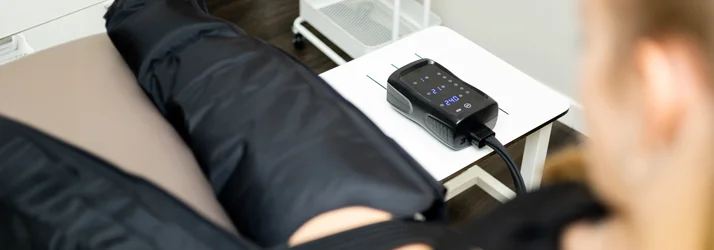
Soft tissue treatment in Albuquerque NM or Rio Rancho NM can help improve tissue mobility, reduce restrictions, and support better movement, but lasting results require more than temporary relief. At Gonstead Physical Medicine, we combine targeted soft tissue techniques with corrective movement, stability training, and progressive loading to help restore function and keep restrictions from returning.
Our soft tissue services include:
- Cupping and Instrument-Assisted Soft Tissue Mobilization
- Dry Needling
- Compression Therapy For Legs & Arms
- Scraping For Any Body Region
Is Soft Tissue Treatment Right For You?
Soft tissue treatment may be appropriate if you're dealing with:
- Muscle tightness or restriction
- Scar tissue or adhesions
- Chronic muscle or tendon pain
- Limited mobility or stiffness
- Pain that returns with activity
Soft tissue treatment is a support tool — not a stand-alone fix.
Why Soft Tissue Work Alone Often Falls Short
Many people feel temporary relief after soft tissue work — then stiffness and pain return.
That's because:
- Tissue quality improves, but movement doesn't
- Poor mechanics continue to stress tissue
- Stability deficits remain
- The body returns to compensation
Without restoring function and control, tissue restrictions often return.
How we use soft tissue treatment differently
At Gonstead Physical Medicine, soft tissue treatment is used strategically, not randomly.
We integrate it to:
- Improve tissue elasticity and glide
- Reduce scar tissue and restrictions
- Prepare the body for rehab and movement training
Then we reinforce those changes through corrective movement, stability work, and progressive loading.
Tissue quality matters — but function makes it stick.
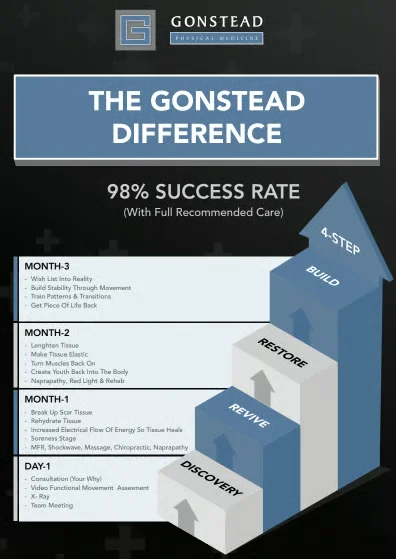
Where Soft Tissue Treatment Fits in your Care Plan
Discovery
We identify tissue restrictions and how they affect your movement patterns.
Revive
Soft tissue treatment helps reduce irritation and restore early mobility.
Restore
As movement improves, soft tissue work supports better mechanics and control.
Build
We use soft tissue techniques as needed to support resilience as demands increase.
What to expect during soft tissue treatment
- Targeted treatment based on your needs
- Techniques may feel intense but are controlled
- Sessions typically last 10–20 minutes
- Often paired with rehab or movement work
Care plans vary based on:
- Tissue involved
- Chronicity of restriction
- Functional demands
What Soft Tissue Therapy Can — and Can’t Do
It CAN:
- Improve tissue mobility and elasticity
- Reduce pain and stiffness
- Enhance movement quality
- Improve response to rehab
It CANNOT:
- Fix faulty movement patterns alone
- Replace strength or stability training
- Override habits that re-create restrictions
That's why our approach focuses on tissue quality plus function — not passive relief alone.
Your First Step Is Clarity
If you're ready to understand whether soft tissue treatment is right for you — and how it fits into a plan that restores function — start with a complimentary consultation.